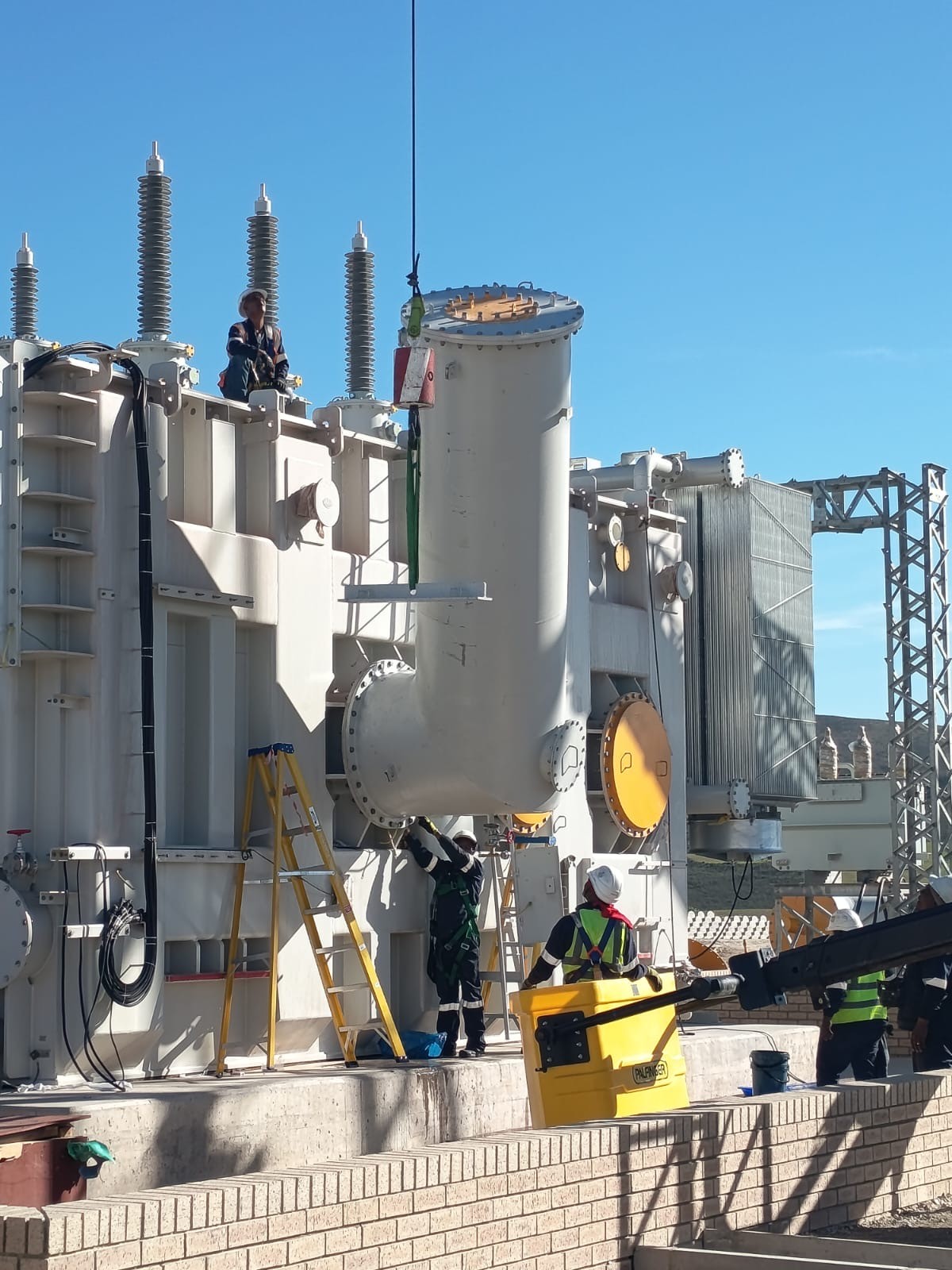
Overberg Wind Farm is being developed and owned by Red Rocket, which is responsible for the project’s development, financing and overall delivery strategy. ACTOM EPC has been appointed to execute the engineering, procurement, construction and commissioning of the 1 000 MVA main transmission substation as part of the broader project.
ACTOM EPC plays a critical role in ensuring the wind farm’s power can be delivered reliably into the grid. It’s this combination of generation and transmission infrastructure that is starting to reshape the scale of opportunity around Swellendam.
This is exactly the kind of infrastructure that changes a region’s trajectory,” says Nicholas Msibi, Divisional CEO of ACTOM EPC. “The substation we’re delivering, one of the largest of its kind in the country, doesn’t just support one wind farm; it’s part of a much bigger investment picture for Swellendam, one that brings billions of rands in associated infrastructure and, with it, the kind of electricity capacity and economic activity that stimulates long-term community growth.”
Msibi notes that the area’s strong wind resource has made it a natural focal point for Independent Power Producers (IPPs), catalysing further infrastructure requirements to support generation and grid integration.
One of South Africa’s largest transmission substations
“Our role is to be an integrator and solutions provider. We conceptualise the engineering solution, complete the detailed design, construct the plant, and commission it for the client,” explains Msibi.
“Because we are part of a manufacturing group, we select the best products for long‑term performance and optimal life‑cycle cost.”
He notes that ACTOM EPC’s turnkey capability contributes to reliable delivery of large-scale infrastructure projects, even on those exceeding a billion rand in value.
Overcoming EPC challenges
Large‑scale Engineering, Procurement, and Construction (EPC) projects demand deep engineering expertise, reliable equipment, and strong execution teams.
“While anyone can learn how to build a substation, it is only through repeated hands-on experience that you understand what is critical for optimal design, construction, and maintainability,” says Msibi.
He highlights ACTOM EPC’s access to proven, locally manufactured equipment, which is a major advantage in a market where inferior components can halt billion‑rand infrastructure. “Even a small part costing R100 000 can stop an entire substation. Our integration with ACTOM’s factories allows us to avoid those risks.”
Technology also plays a central role, and this project incorporates one of the most advanced security systems in the country, including dark‑camera monitoring linked to Eskom’s control centre. ACTOM EPC is also installing a technologically advanced 500 MVA transformer in partnership with an international company.
Building skills and strengthening local communities
ACTOM EPC has prioritised local recruitment, integrating semi‑skilled and unskilled workers from the surrounding communities into its project teams.
“Our local development objectives – aligned with those of Red Rocket – are designed to leave the community with skilled people. By the time we leave, there will be artisans, technicians, and trained personnel ready for future projects,” says Msibi.
He believes the scale and progress of the Overberg Wind Farm project sends a clear signal about South Africa’s engineering strength. “This large-scale collaboration between Red Rocket, ACTOM EPC, and other project stakeholders demonstrates South Africa’s capability to deliver complex energy infrastructure,” he notes.
“It proves that South African companies can deliver complex, high‑value projects to the highest standards.”
He adds that the experience gained through this development is expanding the country’s technical base even further, making this not just a once‑off achievement, but a foundation for the next generation of infrastructure delivery in South Africa.