Dividend per share up 7% to 49.06 cents; office vacancies fall to 9.5%; loan-to-value down to 38.8%
Redefine Properties today announced that the 2026 financial year marked a transition from stabilisation to growth, with key property fundamentals across its South African portfolio at their strongest levels in five years.
That momentum flowed through to earnings, with distributable income rising 7.5% to R3.9 billion and distributable income per share (DIPS) up 7% to 56.08 cents, at the top of the group’s guidance range. The dividend per share increased 7% to 49.06 cents, with a payout ratio of 87.5%, towards the upper end of Redefine’s 80% to 90% range.
The growth came with improved profitability, as the group’s net operating profit margin expanded by 80 basis points to 77.0%. The earnings quality continues to improve with recurring income accounting for 99.6% of group earnings.
The underlying portfolios delivered positive like-for-like growth in net property income (NPI), up 4.1% in South Africa and 4.8% in the EPP Core retail portfolio in Poland.
CEO Andrew König said: “Earnings growth momentum is there, our balance sheet is materially stronger, and operating fundamentals are improving across the board.”
COO Leon Kok said the results were tangible evidence of a recovery in the South African portfolio. “All of our operating metrics are the best they have been since 2022, across occupancy, renewal reversions, retention rates and renewal success rates. The outcomes show that we have turned the corner and things are looking up.” Occupancy across the South African portfolio rose to 94.8%.
South Africa: offices lead the recovery
Offices are providing some of the clearest evidence of that recovery. Redefine delivered on a key target set at its Capital Markets Day earlier this year, reducing office vacancies to 9.5% (FY25: 13.0%), compared with the South African Property Owners Association (SAPOA) national average of 11.8%. Kok said the result reflects the quality of the portfolio, 96% of which is invested in A- and P-grade properties. Stronger leasing is narrowing negative rental reversions (the change in rent when a lease is renewed) to -12.3% from -12.9%, and the focus for the year ahead is to maintain that momentum and bring them into single digits.
Retail rentals are moving higher without putting undue pressure on tenants. Renewal reversions improved to +3% and occupancy remained healthy at 95.2%, while rent-to-turnover stood at 7.4%. “Whenever you sit below 10%, it indicates that your rentals are at affordable levels and you will be able to retain those tenants going forward,” said Kok.
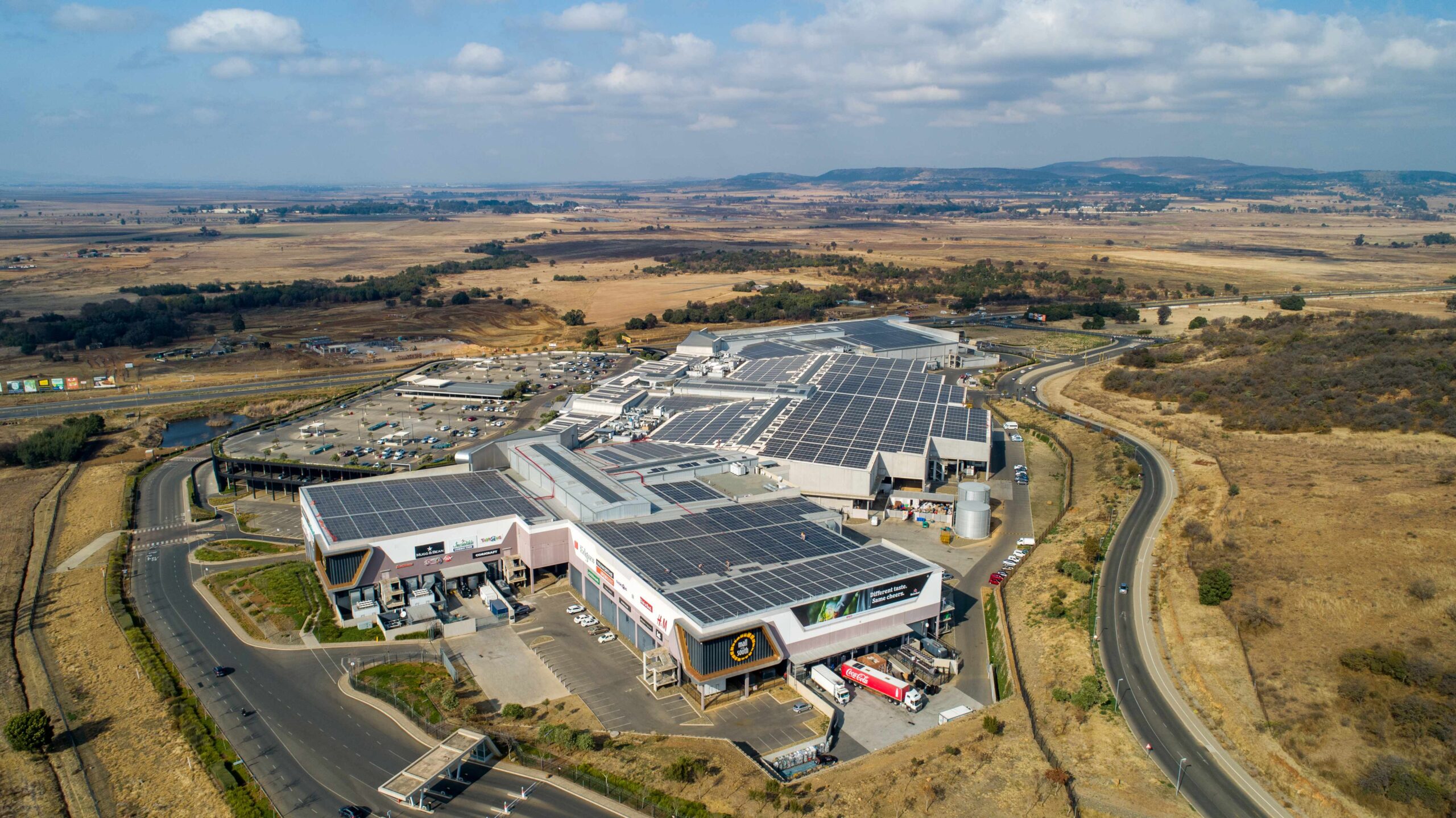
An early bet on renewable energy is beginning to pay dividends. Redefine began investing in solar in 2016, well before large-scale rollouts became commonplace. Installed capacity grew by 11.7 megawatts peak (MWp) during the year to 70.1MWp, helping the group manage rising energy costs and contributing R208 million, or 5.3% of group earnings.
Poland grows its share of earnings
Poland is an increasingly important part of the earnings story, contributing just under 29% of group distributable income, up from just under 24% a year earlier. Occupancy in the EPP Core portfolio is 99.3%, and vacancies in the European Logistics Investment (ELI) portfolio have fallen to 1.5%. The restructuring of the Horse Group joint venture, effective 1 October, has streamlined its ownership and distribution structure.
König said the war in Ukraine has had little impact on the Polish economy, other than bringing more skilled people into economic activity through consumer spending. “It is a handbrake on institutional investment activity, but from an operating point of view it hasn’t impacted us at all,” he said. “The EPP portfolio is basically fully let, the property fundamentals are very positive, and we are probably more affected by the fuel price than by the situation in Ukraine.”
A stronger balance sheet
Behind all of this solid growth sits a balance sheet that has undergone a significant reset in recent years. CFO Ntobeko Nyawo said group loan-to-value (LTV), which peaked at 50% in FY2020, has declined steadily to 38.8% in FY2026, while see-through LTV has fallen from 54.5% to 44.8% over the same period. “Our consistent and prudent risk management has delivered a stronger balance sheet that drives our growth,” Nyawo said. “The real big point for us is that the balance sheet strength has been restored.” Interest cover improved to 2.3 times, undrawn facilities and cash stood at R7.3 billion and cash generation across South Africa and Poland was 99.7%.
The same discipline extends to how Redefine manages its capital sourcing. The group refinanced R13.5 billion of debt while continuing to reduce borrowing margins, including a €323.9 million five-year refinancing at EPP that cut its debt margin by 56 basis points. Group debt margins improved to 1.7% from 1.8%. “Debt margins have continued to improve, born out of our ability to proactively manage our cost of debt throughout the cycle,” said Nyawo.
That flexibility is particularly valuable while the cost of capital remains elevated. König said Redefine has adopted a self-help approach. “We have proven to be resilient when it comes to a high cost of capital. We haven’t looked to shareholders for support. We’ve recycled capital and reinvested in the portfolio, with defensive capital expenditure and selective deployment of capital in new opportunities.”
The South African industrial portfolio is one area where the fundamentals make the case for further investment, with occupancy at 97.2% and renewal reversions of +4.6%. “Industrial continues to be the cornerstone of the South African portfolio’s performance and it will continue to be the area we look to expand from a capital allocation point of view,” Kok explained.
Finding the upside
Redefine enters FY2027 from a stronger financial and operational footing, but expects a tougher environment, with a slowing economy, pressure on consumer spending and higher interest rates. “Our operational momentum will be pitted against geopolitical friction in 2027, but we are entering this period in a far stronger position than we have in previous upward rates cycles,” König said. “Structural does trump cyclical. The market reacts quickly to the cyclical and more slowly to the structural.”
Redefine is guiding for DIPS growth of between 3% and 5% in FY2027, equivalent to 57.7 to 58.9 cents per share, while maintaining its 87.5% payout ratio.
Looking beyond the numbers, König said Redefine’s vision is to be the best REIT in South Africa. “Our theme is finding your upside: what can we unearth in a situation where things will be tested and consumers will be under pressure? We are entering this period with our eyes open, but also on the lookout for opportunities.”