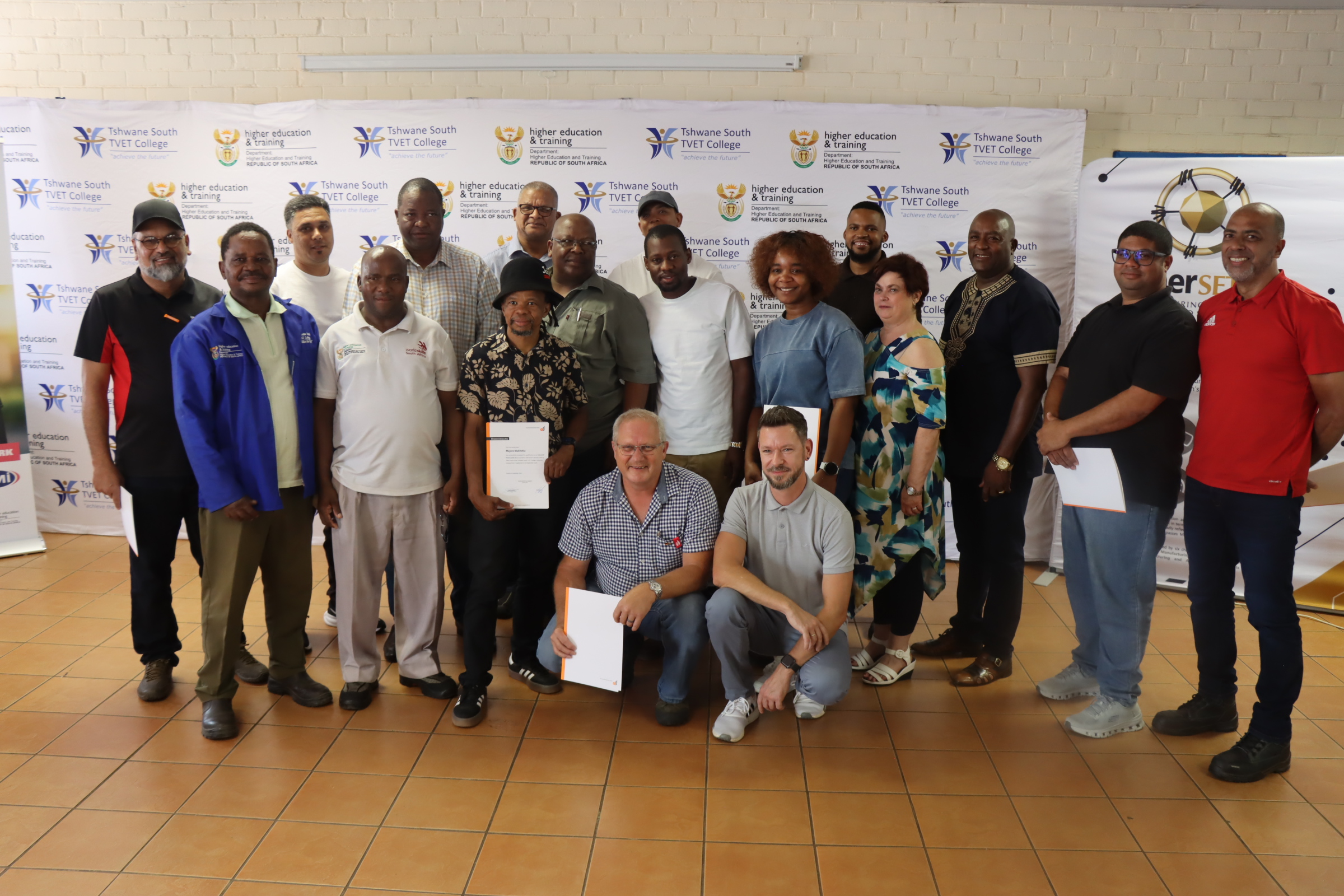
TVET facilitators complete first Level 1S training milestone through the TVET-HWK Partnership Project on Skills Development for e-Mobility
South Africa’s transition to electric and hybrid vehicles depends not only on technology and charging infrastructure, but also on people with the skills to service, maintain and repair these vehicles safely.
An important step has been reached with the completion of the first Level 1S Train-the-Trainers programme for Technical and Vocational Education and Training (TVET) facilitators. The programme forms part of a three-year partnership project on Skills Development for e-Mobility, funded by the German Federal Ministry for Economic Cooperation and Development (BMZ) and implemented by sequa and Handwerkskammer Erfurt (HWK Erfurt), in partnership with South Africa’s Department of Higher Education and Training (DHET) and three TVET colleges.
Held from 9 to 20 November 2026 at Tshwane South TVET College’s Centurion Campus, the 10-day programme brought together facilitators from Tshwane South TVET College, Port Elizabeth TVET College and the College of Cape Town, as well as participants from outside the partner institutions. It combined technical instruction, practical exercises, assessments and specialised teaching methodologies.
The first of three progressive training levels, Level 1S develops foundational competencies for safe work on high-voltage systems. HWK Erfurt adapted the German course to the South African TVET context, strengthening foundational automotive electrical engineering knowledge before progressing to more advanced e-mobility competencies.
Training covered electrical hazards, protective equipment, risk assessments, vehicle identification and labelling, de-energisation procedures, first aid and emergency response involving electric vehicles.
Building skills from the ground up
HWK Erfurt CEO Thomas Malcherek said the first training milestone demonstrated the value of international cooperation.
“We are pleased to share Germany’s experience in developing vocational skills for electric mobility. Our objective is not simply to transfer technical knowledge, but to strengthen local training capacity so South African institutions can develop the skills their automotive industry will need,” said Malcherek.
Strengthening the TVET partnership
The TVET-HWK partnership aims to equip facilitators at the partner colleges to deliver e-mobility training, train the first cohort of students through these institutions and ultimately develop a wider network of qualified trainers able to share their knowledge with educators across South Africa.
Representatives from all three partner colleges participated, with Tshwane South TVET College hosting the programme. DHET supports the initiative as part of efforts to modernise lecturer development and keep training relevant to the evolving automotive industry.
Industry and education working together
While electric vehicles still make up a relatively small proportion of South Africa’s vehicle parc, growth in new-energy vehicle sales and the increasing presence of hybrid technology mean automotive businesses and workshops must begin preparing now. Collaboration between industry, education institutions and skills development partners is critical to building a sustainable pipeline of skilled artisans.
Retail Motor Industry Organisation (RMI) Acting CEO Henk Ferreira said the partnership demonstrates the importance of developing practical responses to emerging skills requirements.
“The transition to electric mobility is changing the skills landscape, and we need to prepare now. The competencies required to work safely with these technologies cannot be an afterthought. Partnerships such as this help prepare our training institutions and industry, while creating opportunities for young people to develop skills that will remain relevant as the sector evolves,” said Ferreira.
Ferreira also acknowledged Porsche AG’s Aftersales Vocational Education (PAVE) team for providing a VW e-Up, which has enabled practical training modules, and merSETA for its support.
A foundation for the next phase
Following successful completion of the training and assessment, participants receive a certificate of completion, providing the foundation for progression to Levels 2S and 3S, planned for the first half of 2027. The levels will build towards fully qualified e-mobility trainers.
By the beginning of 2028, the partner colleges are envisaged to be ready to offer skills programmes preparing young graduates for careers as electric vehicle service technicians, including specialised battery repair competencies.
The completion of the first Level 1S training milestone marks the beginning of a longer-term investment in educators, institutions and the next generation of automotive professionals who will help shape South Africa’s e-mobility future.