City Lodge Hotels has delivered strong revenue growth of 10% from improved occupancies and achieved room rates, and returned value to shareholders by acquiring and cancelling 6.4% of shares in issue.
The group capitalised on the strong economic trends in South Africa in the first half of the financial year and achieved the highest occupancy for nearly a decade. In response to a tougher economic operating environment in the second half of the financial year, the group has responded pro-actively through enhanced dynamic rate management and cost control initiatives.
Highlights of the annual results for the year to 30 June 2026, announced today (10 September) are as follows:
| 2026 | 2025 | ||
| Revenue: | R2.2bn | up 10% | R2.0bn |
| Group occupancy | 58% | up 2% points | 56% |
| Average room rate increase | 7% | no change | 7% |
| Adjusted EBITDAR | R675m | up 15% | R589m |
| Adjusted headline earnings per share (diluted) | 41.6c | up 20% | 34.6c |
| Cash generated by operations | R657m | up 20% | R549m |
| Share buy-back | R153m | (6.4% of total shares in issue) | |
| Dividends declared per share: | |||
| Final: | 11c | up 22% | 9c |
| Interim: | 8c | up 33% | 6c |

Andrew Widegger, Chief Executive Officer, says, “City Lodge Hotels has delivered a good performance. The first half of the year (“H1FY26”) achieved robust occupancy from domestic leisure and business travel, which resulted from improved consumer and investor confidence in South Africa. A stable Government of National Unity marked its first anniversary in June 2025 and reassured the country of political stability and prospects of economic growth. Performance was further aided by additional business activity in and around the B20 and G20 events.”
He notes that the impact of the geopolitical conflict in the Middle East was particularly evident in the last quarter of the financial year as higher fuel costs, inflation and interest rates, curbed discretionary spending, making domestic travel more expensive. This led to a softening in occupancy in the last quarter, albeit slightly ahead of the prior year. Weekend stays and leisure breaks were particularly subdued over this period.
Whilst navigating these headwinds, the group managed to preserve average room rate (ARR) gains and dynamic pricing helped deliver a 7% increase in room rates for the year compared to the prior year.
“International travel has been insulated from the domestic pressures as South Africa continues to be an affordable, sought-after holiday destination. The Western Cape, with five of our hotels having been recently refurbished, benefitted from international travel and achieved a 21% increase in revenue. KwaZulu-Natal, Gauteng and Eastern Cape also delivered good growth,” adds Andrew.
Within SADC, Namibia had stable revenue growth with good occupancy in H1FY26, but softened in the second half. Mozambique’s performance beat expectations and delivered revenue growth in excess of 20%. Botswana’s performance continues to be a challenge as the economy battles to recover from the diamond-market downturn.
FINANCIAL REVIEW

“After a strong start to the year in which we achieved 62% occupancy in H1FY26, the geopolitical tensions and fuel price increases in the second half resulted in an overall 58% (2025: 56%) occupancy for the year,” explains Dhanisha Nathoo, Chief Finance Officer. “The group effectively managed the impact of the weaker second-half occupancy through disciplined room rate management. Average room rates increased by 4% in H1FY26, and accelerated to near double-digit growth in H2FY26, resulting in a full-year increase of 7%, in line with the prior year (2025: 7%).”
She continues, “Total revenue for the year ended 30 June 2026 increased by 10% to R2.2 billion (2025: R2.0 billion) with rooms revenue increasing by 9% to R1.74 billion (2025: R1.59 billion). The food and beverage (F&B) offer continues to broaden, as we have added bespoke identity restaurants to three of our hotels. F&B revenue grew by 14% to R449.9 million (2025: R393.2 million), and now accounts for 20.4% (2025: 19.7%) of total revenue.”
“Cost containment remains a key area of focus, as we try to mitigate the above inflation increases in utility costs, and the failing municipal services, which often result in additional contingent supply costs. Inflation spiked in the second half of the year following the fuel price increases caused by the Middle East conflict. Total operating costs increased by 9%, but operating costs per room sold only increased by 6%,” Dhanisha explains.
The combination of strong revenue growth and well controlled costs delivered an Adjusted EBITDAR (which excludes unrealised foreign exchange (losses)/gains and exceptional items) growth of 15%, and an Adjusted EBITDAR margin increase of 1.1% points to 30.6% (2025: 29.5%).
A 7% increase in salaries and wages to R631.9 million (2025: R588.5 million) was largely aligned to the annual inflationary increase of 5.5%, but included additional staff required to support the increased occupancy and F&B volumes. Property costs have increased by only 5.3% to R197.0 million (2025: R187.0 million). The group continues to prioritise renewable energy from solar generated power at 40 hotels and borehole and filtration water supply at 14 hotels to mitigate the average 13% municipal utility price increases over the last year.
Rooms related costs and F&B costs are mainly variable in nature. The increased occupancies grew room related costs by 11% to R226.1 million (2025: R204.3 million). This was partly due to the increase in commissions payable for additional corporate and government segment sales. F&B costs increased by only 13% to R170.2 million (2025: R150.7 million), compared to F&B revenue growth of 14%. These efficiencies improved F&B gross profit margins to 62.2% from 61.7% in the prior year.
The strengthening of the South African Rand resulted in an unrealised loss on foreign exchange of R28.7 million (2025: R7.9 million) mainly in Mozambique on the intercompany Rand denominated loan.
Depreciation for the year of R201.2 million (2025: R180.3 million) includes depreciation of capitalised leases. The 12% increase relates to additional depreciation on newly refurbished hotels.
Lease related expenses (i.e. depreciation on right-of-use assets of R95.3 million and interest expense on leases of R126.6 million) exceeds cash lease payments of R184.6 million by R37.3 million.
Taxation amounting to R106.9 million (2025: R98.4 million) increased by 9%. Taxation includes a R7.7 million impairment of the deferred tax asset in Botswana due to its subdued performance and R1.8 million in Namibia due to changes in tax legislation.
Profit after tax of R203.0 million (2025: R213.0 million) decreased by 5%, and diluted earnings per share increased by 1% to 38.7 cents (2025: 38.3 cents).
Dhanisha is pleased to report, “Adjusted diluted headline earnings per share, which excludes unrealised losses on foreign exchange and exceptional items (the impairment of the deferred tax assets), has increased by 20% to 41.6 cents (2025: 34.6 cents).”
STRATEGIC UPDATE
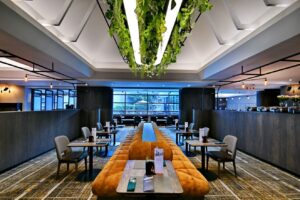
City Lodge Hotels continues to optimise its strong balance sheet position and robust cash generated by operations of R656.9 million (2025: R548.6 million) by reinvesting in its hotels. In addition, the group acquired and cancelled 38 million shares in issue (6.4% of total shares in issue at the beginning of the financial year) at an average price of R4.02 per share, for a total consideration of R152.8 million.
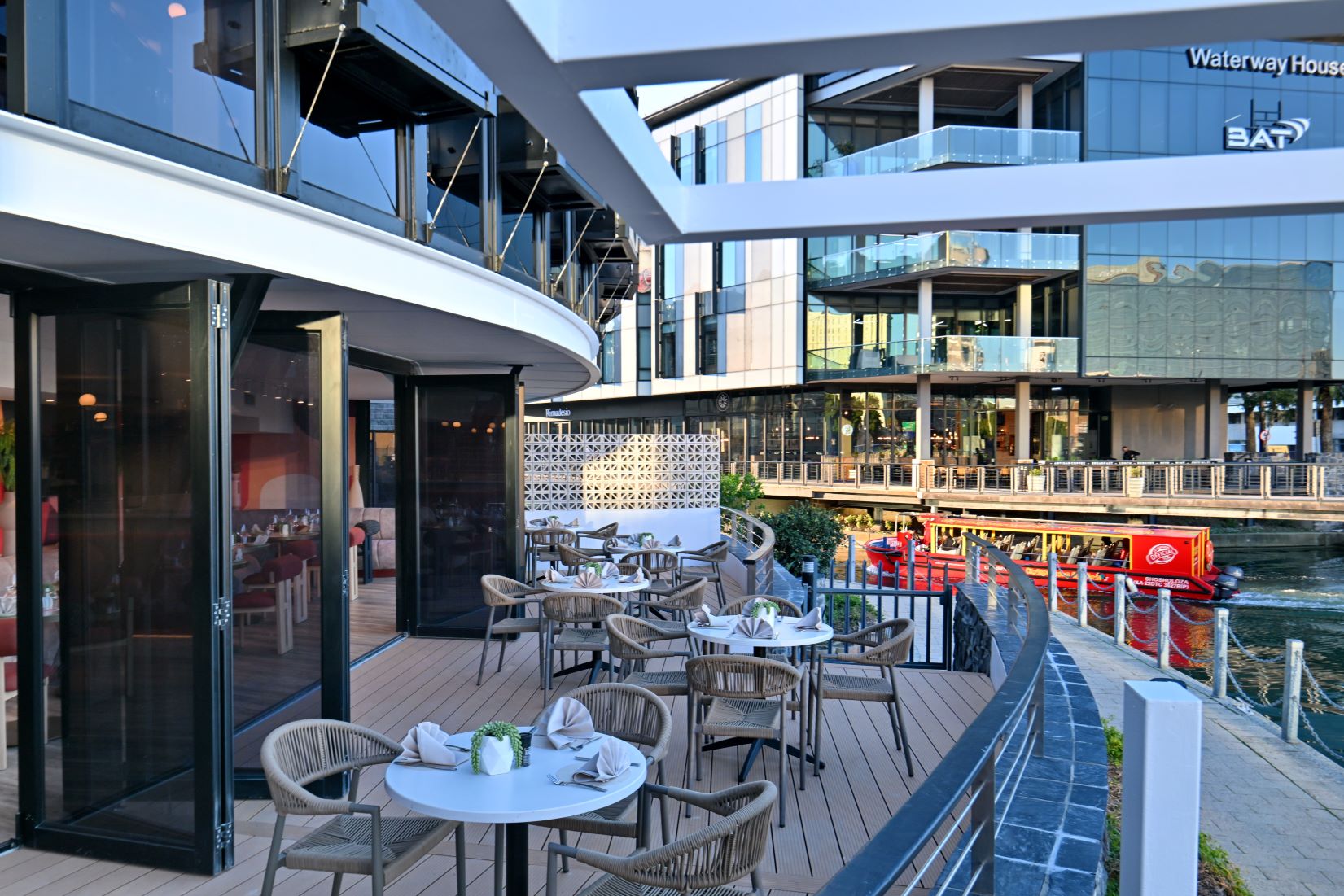
“Capital has been allocated to strengthen the hotel portfolio and align the product with our new generation brand standards, delivering more value to our guests. These include the modernisation of three hotels (City Lodge Hotel (CL) Johannesburg International Airport, Courtyard Hotel (CY) Gqeberha and CY Sandton) and three bespoke restaurant refurbishments (CL V&A Waterfront, CL Umhlanga Ridge and CY Gqeberha). Two further hotel refurbishments are in-progress at CL Sandton, Morningside and Road Lodge (RL) Gqeberha. The group spent R234.0 million (2025: R260.5 million) on capital expenditure during the year,” comments Andrew.
“The group also optimised the performance of the portfolio through the sale of CY Arcadia (closed in December 2025), and by not renewing the lease for CL Newtown (closed in March 2026). Both hotels were loss making and had been impaired in previous years,” he continues.
OUTLOOK
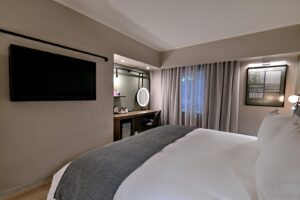
Disciplined refurbishment plans continue to be prioritised at targeted hotels to deliver optimal and sustained returns. The group intends to complete the current refurbishments at CL Morningside Sandton and RL Gqeberha in H1FY27, with a further four hotel refurbishments planned to commence during the year. These include CL Fourways, Town Lodge (TL) Roodepoort, TL Gqeberha and RL Johannesburg International Airport.
The group is actively pursuing expansion opportunities, specifically in areas such as, Western Cape and KwaZulu-Natal. In addition, the construction of the 53-room expansion at CL Waterfall City is scheduled to commence in September 2026 and to be completed in June 2027.
“We are investing in innovative technologies which aim to improve the guest experience, create operational efficiencies and deliver improved productivity,” says Andrew.
Environmental sustainability and resilience solutions continues to be a priority to mitigate the water and electricity supply challenges and high annual cost increases. Phase 3 of our solar installation roll-out and the addition of more water resilience and sustainability solutions have been earmarked for financial year 2027.
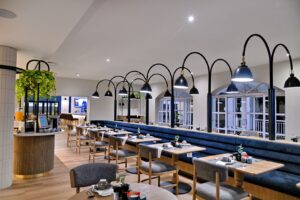
Looking ahead, Andrew says, “The South African economic outlook is marred by the global uncertainty caused by the Middle East conflict, the resulting oil shortages and its impact on the price of fuel. There is continued risk of higher inflation and interest rates, putting upward pressure on food prices, consumables and transport costs, leading to constraints on disposable income. However, when stability returns, domestic policies have displayed good prospects for economic growth aided by improved investor and consumer confidence.”
He continues, “In response to these headwinds, the group is well-positioned to manage longer term disruptions. We are vigilant and responsive to the changes in demand and price pressures. Pressure from low weekend demand is balanced by good midweek demand and promotions, where appropriate.”
Group occupancies for July and August 2026 were 59% and 62%, respectively (July and August 2025: 60% and 59%, respectively). Month to date occupancy, up to 9 September 2026, is up by four percentage points to 65% (2025: 61%). The ARR improvements remain consistent with the second half of the financial year, with year to date up to 9 September 2026, achieving an increase of 10%, and total revenue growth of 10.4% compared to the same period in the prior year.
DECLARATION OF DIVIDEND
Dhanisha concludes, “The board has approved and declared a final dividend (number 70) of 11.00 cents per ordinary share (gross) (2025: 9.00 cents) in respect of the year ended 30 June 2026.”