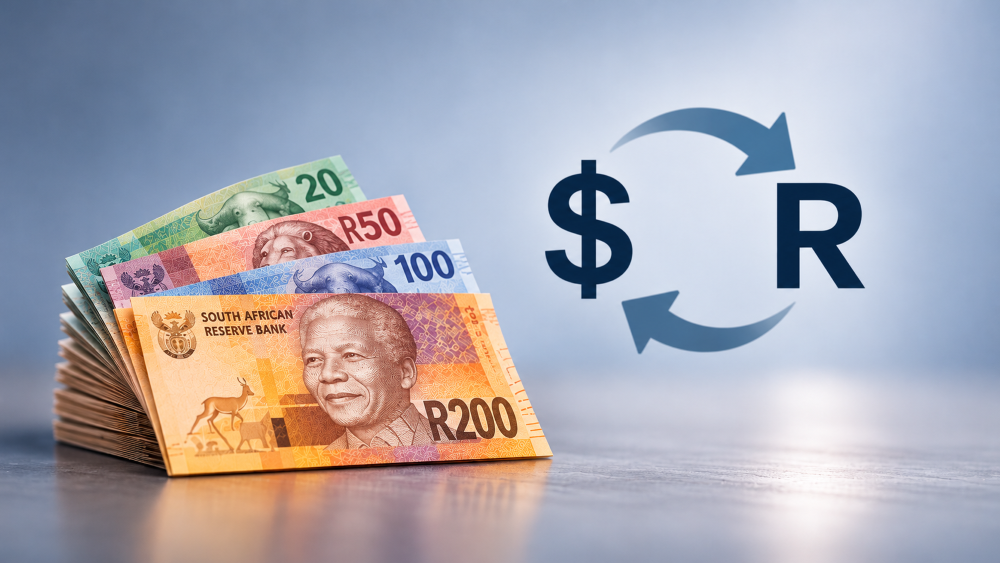
Imagine, for a moment, that you’ve got R1 million that you need to get offshore. Maybe it’s for a deposit on an overseas property ahead of a move there, or maybe you want to increase your offshore exposure.
With the rand improving against major currencies (largely off the back of a softer dollar) in recent weeks, the temptation might be to wait and see if it keeps improving. But is holding off for a better rate worth the risk?
According to Harry Scherzer, CEO of currency exchange fintech Future Forex, the answer depends on how much risk you’re prepared to accept. And if you’re going to try to time currency markets, you have to be prepared to accept significant risk.
Why timing the rand is a gamble
“Short-term currency moves are driven by global risk appetite, interest rates, commodity prices and local news, often all at once,” says Scherzer. “Even professional analysts struggle to call the direction of a currency over weeks or months.”
“Waiting for further improvements in the rand can backfire if the currency weakens instead,” the Future Forex CEO adds. “So, if you’re holding out for a better rand, you may end up worse off. That’s not to say one approach is automatically better than the other, but you should always be as informed as possible before making a major international transfer.”
What a R1 change in the exchange rate does to R1 million
Of course, exchange rate fluctuations can significantly affect the transfer of such a large sum. If you were transferring R1 million into US dollars, you’d get about US$58,824 at R17 per dollar. But if the rand weakened to R18 per dollar, you’d end up with US$55,556. That’s a difference of about US$3,268 before fees.
These figures are purely illustrative, not a forecast. The rand could just as easily strengthen to R16, and moves of this size can happen quickly. When Jacob Zuma briefly appointed Des van Rooyen as finance minister in 2015, for example, the rand went from R14.40 to the dollar to R15 and above. Few saw it coming, illustrating how hard it is to know where the currency will go next.
Flexible investor versus fixed deadline
According to Scherzer, what you plan to do with the money can help guide whether or not you should risk timing the market.
“If you’re a long-term investor, you won’t really have a hard date by which you need to make the transfer,” he says. “That means you have more room to wait or phase your transfers in. That said, time in the market may matter more than when you make the initial transfer.”
“But if you’re making the transfer to buy property, for example, you may have a fixed settlement date and a set amount in foreign currency, so certainty matters more than squeezing out a better rate,” he adds. “Especially given that a sudden fall, rather than rise, in the rand could leave you with a shortfall.”
As such, Scherzer suggests starting from the deadline and working backwards from there.
All at once or in stages
It’s also worth considering whether you should make the exchange all at once or in tranches. Sending it all at once means one rate for the full amount, good or bad.
Staggered transfers, on the other hand, allow you to spread the amount over weeks or months to reduce the reliance on a single rate. Of course, staging does not guarantee a better average and may add costs or admin to each transfer. It may then be best suited to people who want to limit regret, rather than maximise the rate.
Look at the total cost, not just the fee
Scherzer further notes that it’s important to look at the total cost of an international transfer, not just the fee.
“Anyone making an international transfer needs to be especially careful of the exchange-rate spread,” he says. “Simply put, this is the gap between the market rate and the rate your provider gives you. It can make a big difference to what you receive, especially when low-or-zero fee transfers hide a wide spread.”
Plan before you convert
Finally, a large transfer may take more than a few taps in your banking app. There may also be paperwork involved, including SARS Approval for International Transfer (AIT) and supporting documents for amounts above the R2 million single discretionary allowance, the amount you can send offshore without tax clearance. If you build processing time into the plan, your deadline won’t force a rushed conversion at a poor rate.
“Ultimately,” Scherzer concludes, “you should decide on a strategy that fits your timeline and needs, rather than chasing the perfect rate.”