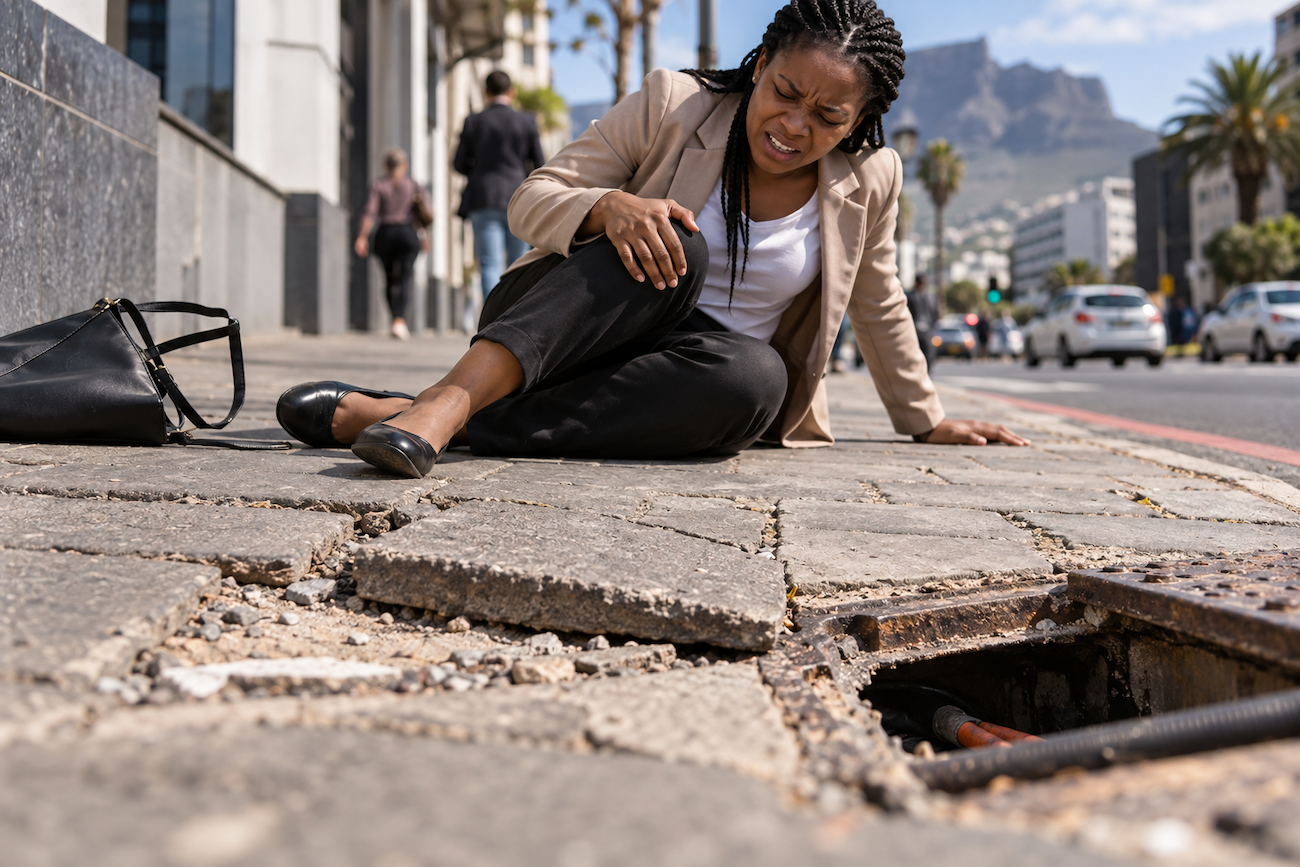
A cracked paving slab or uncovered utility hole may seem like a minor municipal maintenance issue; for injured pedestrians, however, it can result in life-changing injuries, lengthy legal battles and growing financial pressure on already cash-strapped municipalities.
As South Africa’s infrastructure continues to deteriorate, personal injury attorneys are reporting increasing claims from people injured after tripping on broken sidewalks, uneven paving and unrepaired municipal infrastructure. While municipalities have a legal duty to maintain public walkways, recent court decisions show that liability is far from automatic.
“Municipalities have a responsibility to keep public infrastructure reasonably safe, but every case turns on whether the authority acted reasonably in the circumstances,” says Kirstie Haslam, partner and personal injury attorney at DSC Attorneys.
“The courts recognise that municipalities operate with finite resources, but that doesn’t excuse dangerous hazards being ignored,” she says. “If a municipality knew, or reasonably should have known, about a hazardous defect and failed to act, it can be held liable for the injuries that follow.”
The issue comes as South Africa’s municipalities continue to battle ageing infrastructure, constrained maintenance budgets and service delivery backlogs. According to the latest Auditor-General reports, many municipalities continue to struggle with infrastructure asset management and maintenance planning, contributing to deteriorating public infrastructure across roads, pavements and public spaces.
Haslam notes recent court judgments to illustrate how finely balanced these claims can be.
In Schaefer v City of Cape Town (2025), the Western Cape High Court dismissed a claim brought by a woman who fractured her kneecap after tripping on a raised paving brick in Camps Bay. The court held that the defect was relatively minor, there was no evidence the City knew about it, and municipalities cannot reasonably be expected to maintain every pavement in pristine condition.
The judgment reaffirmed that municipalities owe pedestrians a legal duty to maintain sidewalks that do not present an unreasonable risk of harm, but that negligence must still be proved in each case.
The court adopted a similar approach in Meje v City of Cape Town (2026), involving a pedestrian who fell after stepping into an uncovered service opening while chasing suspected thieves. The judgment again emphasised that wrongfulness depends on the nature of the defect, whether the municipality knew about it, whether the danger was reasonably foreseeable, and whether the injured person also contributed to the incident.
She says that by contrast, courts have also found municipalities liable where pavements had deteriorated into dangerous disrepair.
In Bland v AbaQulusi Municipality (2024), the KwaZulu-Natal High Court accepted evidence that a pedestrian had fallen because of a hole in a badly deteriorated pavement. The court confirmed that public pavements are intended for pedestrian use and should not be allowed to deteriorate into hazardous conditions.
“Although damages in many of these cases are determined separately after liability has been decided, successful claimants may recover compensation for medical expenses, loss of earnings, future medical treatment and general damages depending on the severity of their injuries,” she adds.
Haslam says evidence is often the deciding factor.
“Photographs taken immediately after the incident, witness statements, medical records and proof that the municipality had prior notice of the defect can significantly strengthen a claim,” she explains. “Equally, municipalities frequently defend these matters by arguing that the danger was obvious or that the pedestrian failed to take reasonable care.”
Haslam adds that these claims are likely to increase as municipalities struggle to maintain ageing infrastructure while urban populations continue to grow. “The real issue isn’t simply individual lawsuits.”
“Every successful claim represents infrastructure that should have been repaired before someone got hurt,” she concludes. “Preventative maintenance is almost always cheaper than litigation, compensation and the long-term human cost of avoidable injuries.”